
Training from the Leaderships Perspective
https://vimeo.com/1226072127?share=copy&fl=sv&fe=ci The Conversation A Trainer in the Chief’s Chair What I learned about leadership from Chief Jay Gerace and the
Testifying Without Scientific Authority
The Discipline of the Practitioner-Expert Who Relies on the Research
By Jamie Borden
Critical Incident Review, LLC
At some point in nearly every deposition, the question arrives, and it is always delivered as though it were a trap: “You’re not a scientist, are you?” Opposing counsel leans on the word scientist the way a locksmith leans on a pick, waiting for something to give. My answer is one word. “No.” It is an easy answer, and the ease has nothing to do with the moment it is spoken. It is easy because it is true, and because the months of work that came before it were done in the light of that truth. The report sitting on the table between us claims no authority I do not hold, so the word “no” takes nothing from it.
That is the subject of this article. Those of us who investigate, analyze, and testify about critical incidents, police use-of-force events in particular, work in the shadow of a genuine dilemma. The peer-reviewed research on human performance is directly relevant to what we do. It describes how officers identify unknown objects under time compression, why verbal skills degrade under threat, how long it takes a human being to perceive and react, and what memory can and cannot deliver after a life-threatening event. We would be negligent to ignore it. And yet we are not the ones who produced it. A deeply specialized education in this field, decades of training and casework, thousands of hours of video review, none of it confers scientific authority. I cannot opine as a scientist or a human factors researcher, and I do not. The discipline of relying on the research without borrowing its authority is not a limitation I tolerate. It is a methodology I have built on purpose, and I believe it is the most thoughtful and most defensible way this work can be done.
Every statement in an expert report can be assigned to one of two lanes. In the scientist’s lane live claims about what an experiment demonstrates, whether its methods were sound, what its statistics mean, and how far its findings generalize. In the practitioner’s lane live claims about what officers are trained to do, what generally accepted practice looks like, what a policy requires, and what a video record actually shows, frame by frame, within the known limits of the medium. I drive only in the second lane. The research literature appears in my reports the way it appears in the profession itself, as context that informs and corroborates practitioner judgment, never as the foundation that pretends to prove it.
The test I apply to my own work is blunt: if every research citation were struck from the report tomorrow, would the opinions still stand on training, experience, and methodology? If the answer is no, then the opinion was never mine to give, it was a scientific conclusion wearing a practitioner’s signature, and it comes out of the report before anyone else ever reads it. If the answer is yes, the citation is doing its proper job: showing the reader that my professional position is not idiosyncratic but consistent with what the research community has found. The distinction sounds simple. Holding it, line by line, across a sixty-page report, under the pressure of advocacy on both sides, is where the effort lives.
There is a version of this work that skips the effort. It quotes abstracts, cites studies it has not fully read, converts laboratory findings into courtroom certainties, and announces that “the science proves” whatever the retaining party needs proven. It survives until it meets a prepared examiner, and then it does not merely fail, it takes the whole report down with it, including the parts that were sound. The alternative I am describing costs more up front. It requires reading the studies in full, understanding what they measured and in whom, carrying their limitations forward honestly, and writing every research-adjacent sentence so that it claims exactly as much as the source can bear and no more. That cost is the point. The effort is not overhead on the credibility; the effort is the credibility.
Four bodies of research recur in critical-incident analysis, and each one presents the same temptation and the same discipline.
Mistake of fact. A meaningful share of fatal officer-involved shootings involve subjects who turned out to be unarmed or holding something other than a weapon. The research community has begun to isolate why. In one study, experienced officers viewed point-light displays, moving dots representing only the body’s motion, of a person drawing a gun, a knife, a phone, or a wallet from concealment (Connelly, Suss, & Vangsness, 2023). Officers could not reliably tell weapon from non-weapon on the motion alone. What drove their answers was the manner of the draw: threatening presentations were called weapons, compliant presentations were called non-weapons, regardless of the object. Years of service made no measurable difference. In a report, this literature explains why a category of perception error is documented among trained, experienced officers, which matters enormously when an officer says “I thought it was a gun” and the object was a wallet. What it can never do is tell anyone what this officer perceived on this night. The literature contextualizes the account; the record is what tests it. The standard I hold in my reports is that those two sentences never share a paragraph, and that no “therefore” bridges them.
Action versus reaction. The reaction-time literature addresses a reality that reviewers consistently underestimate, as the studies describe it, action beats reaction, and the margin is not small. Controlled studies have measured the intervals involved, the time a suspect needs to raise a weapon and fire versus the time an officer needs to perceive the change and respond (Blair et al., 2011), and those findings are consistent with what firearms instructors consistently observe on the range and what training doctrine has long taught: that by the time a threat is unambiguous, the window for response has largely closed, and that decisions already in motion do not stop on a frame boundary. In video analysis this context is indispensable, because video invites the viewer to pause at the exact frame where the threat becomes visible and to grade the officer against a freeze-frame no human being ever saw. The literature earns its citation by explaining why real-time perception and slow-motion review are different events. The over-reach, quoting precise millisecond figures as though they were constants of nature, or applying a laboratory average to a specific officer as though it were his measured capability, is exactly the move a prepared examiner is waiting for.
De-escalation. The modern allegation of choice is “failure to de-escalate,” and it typically arrives carrying an assumption: that de-escalation is a switch, available at all moments to any willing officer. The psychophysiology literature complicates that assumption honestly. A dedicated research collection on the psychophysiology of police decision-making (Andersen, Arble, & Collins, 2020) summarizes field studies finding that physiological arousal does not degrade all skills equally, verbal communication skills suffer measurably while heavily trained, near-automatic skills are comparatively preserved, and that these responses appear malleable through training history and physiological readiness. For the practitioner-expert, this reframes the analytical question in precisely the way the facts deserve: not whether an officer de-escalated in the abstract, but whether the conditions under which those trainable, perishable, stress-sensitive skills operate, time, distance, cover, a subject responsive to communication, were actually present. The equal and opposite over-reach also has to be named: the literature does not prove that officers under stress cannot talk, think, or choose, and a report that says so has left the practitioner’s lane just as surely as the allegation it was answering. The same discipline applies to the source itself: an editorial overview is a map of the literature, not a finding, and when a specific result matters to an opinion, the citation runs to the study that produced it.
Memory and cognition. Nothing in this field generates more unearned suspicion than the gap between an involved officer’s account and the video. The memory research explains the gap without excusing anyone. That research describes memory not as a recording but as a reconstructive process that encodes selectively under stress, and it reports that an officer actively responding to a threat encodes the event differently, and recalls less of certain details, than an observer standing feet away (Hope et al., 2016). In a report, this literature does one narrow and valuable thing: it establishes that an honest account and an accurate video can diverge, that discrepancy alone is not evidence of deception, and that the fluency of a later interview is not a fair benchmark for what was perceivable mid-event. What it must never become is a solvent that dissolves every inconsistency. The literature does not certify any particular account as honest, and an analyst who deploys “memory science” to explain away whatever the video contradicts has simply inverted the misuse, the same borrowed authority, pointed the other direction. My reports state the discrepancy, present the research context for why such discrepancies occur among truthful witnesses, and leave the credibility determination exactly where it belongs: with the trier of fact.
Everything above converges on a single document. By the time I am sitting across from opposing counsel, the testimony has, in every meaningful sense, already been given, in the report. Deposition preparation, done properly, is not a rehearsal of answers. It is an audit, and I conduct it against my own work product as adversarially as I expect the examiner to. Every report I sign is written in anticipation of that audit, which means the standards are not applied retroactively during prep; they are the drafting standards themselves.
The audit asks five questions of every research-adjacent passage. First, the strike test: does the opinion survive the removal of the citation? If a conclusion leans on the study rather than being corroborated by it, it is rewritten or removed. Second, the page test: can I point to the proposition on the pages of the source itself, not the abstract, not a secondary summary, not a training-conference paraphrase? The discipline here is to cite nothing that has not been read in full, and never to cite an abstract’s promise when the limitations section takes it back. Third, the lane test: is every sentence assignable to the practitioner’s lane, with anything that drifts toward mechanism, cortisol, heart rate, “the amygdala”, either removed or restated as an attributed, general summary of what researchers report? A sentence that diagnoses a specific officer’s physiological or cognitive state at a specific moment fails this test automatically, because no one measured it and I am not qualified to infer it. Fourth, the limitations test: does the limitation travel with the finding, in the same passage, in plain language? Disclosing a study’s limits before being asked is not a concession; it is the difference between an expert who names the boundary and an expert who has it extracted on the record. Fifth, the file test: is the source itself, the full paper, not a printout of its abstract, in the case file, cited completely, so that everything I relied on is inspectable by anyone who asks?
A report that passes those five tests produces a particular kind of deposition. The “you’re not a scientist” question lands on nothing, because the report never claimed the authority being challenged. The “doesn’t this study have limitations” question is answered by the report itself, which disclosed them first. The invitation to defend a study’s statistics is declined in one sentence, that question belongs to the researchers and to qualified human factors experts, and the decline costs nothing, because no opinion in the report depends on my winning that argument. Counsel is left to cross-examine my actual lane: the record, the training, the policy, the analysis. That is the cross-examination I have spent a career preparing for, and it is the one I am supposed to face.
There is a question that comes before all five of those tests, and it deserves its own discipline: does the citation belong in the report at all? The strongest sentence in any report I write cites the evidence, not a journal. The evidence is specific, this video, this timeline, this distance, these commands given and these responses to them, this officer’s training record, this policy in effect on this date. The science is general by design; that is what makes it science, and it is also what makes it the weaker authority on the only question the reader actually has, which is what happened here. When the record answers a question, the study stays on the shelf. I do not cite research to establish something the evidence already establishes, and I do not reach for a study to fill a gap the evidence leaves open, a gap in the evidence is a finding in itself, and it gets reported as one.
This means research data is cited only where it is applicable, where a specific fact in this record raises the specific question the study speaks to. An officer’s account that diverges from the video makes the memory literature applicable. An unarmed subject who drew an object in a threatening manner makes the mistake-of-fact research applicable. A demand to know why the officer did not deliver a fluent verbal intervention mid-struggle makes the psychophysiology of arousal applicable. Absent that connecting fact, the citation is decoration, and decoration in an expert report is never neutral. The working test is simple to state and unforgiving to apply: for every citation, name the fact in the record that makes this study speak to this case. If I cannot name the fact, the citation comes out.
Citation density carries a message of its own, and it is worth hearing before opposing counsel delivers it. A report that opens with a literature review and salts every page with studies does not read as analysis; it reads as a brief, as an analyst who arrived with an explanation and went looking for a fact pattern to attach it to. In this arena, that posture has a name, and it will be said out loud: advocating and excusing. The moment the science outweighs the evidence on the page, the examiner’s theme writes itself, that the expert is not analyzing what the officer did but excusing it in advance, with borrowed authority, the same way for every officer in every case. A minimal citation set leaves that theme nothing to attach to, not because the citations have been managed for appearance, but because every source on the page is there for a reason the record itself supplies. My reports typically carry a small number of sources, each one tethered to a named fact in the record, each one doing work no evidence could do, and nothing else. The reader should finish the report certain of what the evidence showed and merely informed of what the research context was. When those proportions reverse, the report has stopped analyzing the incident and started defending it, and no citation format can fix that.
I want to be clear about what this discipline is not. It is not scientific timidity, and it is not a diminished role. The practitioner-expert who refuses to over-claim is not doing less than the one who recites effect sizes with borrowed confidence, he is doing considerably more. It takes no effort at all to write “science proves the officer couldn’t have seen the wallet.” It takes real effort to write the version that is true: that peer-reviewed research documents this category of error among experienced officers under controlled conditions; that the research did not and cannot measure this officer; that the record shows what it shows; and that the analysis of that record stands on its own methodology. The first version is louder. The second version is still standing at the end of the deposition.
There is also a professional obligation running beneath all of this. Our field asks courts, review boards, and communities to trust that police practices can be evaluated rigorously by the people who know them best. Every practitioner who inflates a study into a verdict spends down that trust for all of us; every report that carries the research honestly, at its actual weight, with its actual limits, builds it back. The researchers have done their part with a candor worth imitating: the studies I rely on are the first to state what they did not establish. The least we owe them, and the most we owe the process, is to quote them the way they wrote.
So when the question comes, and it will come, “you’re not a scientist, are you?”, the answer is no. I am the other thing: a practitioner who has spent a career in the field the scientists study, who reads their work in full, cites it for exactly what it holds, and testifies from a lane I have no need to leave. That answer is not a retreat from expertise. It is what expertise sounds like when it has been audited before anyone else had the chance.
Andersen, J. P., Arble, E. P., & Collins, P. I. (2020). Editorial: De-escalating threat: The psychophysiology of police decision making. Frontiers in Psychology, 11, 1112. https://doi.org/10.3389/fpsyg.2020.01112
Blair, J. P., Pollock, J., Montague, D., Nichols, T., Curnutt, J., & Burns, D. (2011). Reasonableness and reaction time. Police Quarterly, 14(4), 323–343. https://doi.org/10.1177/1098611111423737
Connelly, M. E., Suss, J., & Vangsness, L. (2023). Using biological motion to investigate perceptual–cognitive expertise in law enforcement use-of-force decisions. Journal of Police and Criminal Psychology. https://doi.org/10.1007/s11896-023-09575-5
Hope, L., Blocksidge, D., Gabbert, F., Sauer, J. D., Lewinski, W., Mirashi, A., & Atuk, E. (2016). Memory and the operational witness: Police officer recall of firearms encounters as a function of active response role. Law and Human Behavior, 40(1), 23–35. https://doi.org/10.1037/lhb0000159
About the author: Jamie Borden is the founder of Critical Incident Review, LLC, and a retired law enforcement professional who serves as a trainer, investigator, analyst, and retained expert in police practices and critical-incident video analysis.
CRITICAL INCIDENT REVIEW, LLC
Training and Analytical Standards Series
TRAINING PROTOCOL
Referencing Peer-Reviewed Research in Use-of-Force Training, Policy Development, and Investigative Analysis Without Assuming Scientific Authority
Working Example: Connelly, Suss, & Vangsness (2023), Journal of Police and Criminal Psychology
Prepared for investigators, analysts, and instructors operating in the training and investigative realm
This protocol establishes the standard by which investigators, analysts, and instructors working under or alongside Critical Incident Review, LLC refer to, cite, and apply peer-reviewed scientific research in three settings: the training environment, the policy-development environment, and the investigative and analytical environment, including expert reporting and testimony. It is written around a single dilemma that every practitioner-expert in this field must resolve correctly, every time: we are consumers of the science, not producers of it. We do not hold scientific authority, and we must never write, testify, or teach as though we do. At the same time, we would be professionally negligent to ignore a body of research that directly describes the perceptual and decision-making phenomena we are asked to train on, write policy around, and analyze after the fact.
The resolution of that dilemma is not to avoid the science and it is not to lean on it. It is to place the science in the correct position within our work: as context that informs a practitioner opinion, never as the foundation that pretends to prove one. This protocol teaches that placement using a concrete example, the Connelly, Suss, and Vangsness (2023) study on biological motion and unknown-object identification, because it is precisely the kind of study our field will be tempted to over-use.
A deeply specialized education in this field, decades of training, instruction, case review, and video analysis, does not confer scientific authority. I cannot opine as a scientist or as a human factors researcher, and neither can you. The researchers who ran the study, designed the stimuli, and performed the statistical analysis hold that authority for their findings; they are also, notably, the first to state the limits of those findings. What we hold is different: practitioner expertise in police training, tactics, policy, investigation, and analysis. Courts, agencies, and review boards ask us for opinions grounded in that expertise. The research literature is one of the inputs that keeps our expertise current and defensible, the same way generally accepted training doctrine (interdepartmentally), model policy (as adopted by the agency), and case experience do.
The failure modes sit on both sides of this line. The first failure is over-emphasis: quoting effect sizes as if they were field-validated facts, telling a jury that “the science proves” an officer could not have perceived something, or converting one laboratory finding into a universal law of human performance. That posture will not survive a qualified opposing expert or a competent cross-examination, and it should not, it is a misrepresentation of both the study and our role. The second failure is abdication: refusing to engage the literature at all, which leaves our training anecdotal, our policy positions unanchored, and our analytical opinions exposed as mere say-so. The protocol below is designed to keep our work off both rocks.
One framing that has served this practice well applies here. In video analysis we distinguish the bad optic from the bad fact: what looks damning on screen is not always what happened, and the analysis must say what is actually known, no more and no less. Research citation demands the same discipline. A study that appears to support our position is an optic; what the study actually measured, in whom, under what conditions, and with what stated limitations, that is the fact. We cite facts.
Every statement we make about research must be assignable to one of two lanes.
The scientist’s lane. Claims about what an experiment demonstrates, the validity of its methods, the strength of its statistics, and the generalization of its findings to conditions it did not test. We do not drive in this lane. When a question belongs here, the correct answers are of the form: “That is a question for the researchers,” “The authors address that in their limitations section,” or “A human factors expert would be the appropriate witness on that point.”
The practitioner’s lane. Claims about training design and industry practice, about what officers are and are not trained to do, about generally accepted concepts in law enforcement performance, about policy sufficiency, and about what a video record does and does not show. This is our lane, and within it we may, and should, state that our positions are consistent with, and informed by, the peer-reviewed literature. The literature corroborates the practitioner opinion; it does not substitute for it.
The operational test is simple. Before citing a study, ask: if this study were struck from my report tomorrow, would my opinion still stand on my training, experience, and methodology? If the answer is no, the opinion was never yours to give, it was a scientific conclusion wearing a practitioner’s signature, and it must be reframed or removed. If the answer is yes, the citation is doing its proper job: showing the reader that your professional position is not idiosyncratic, but consistent with what the research community has found.
To cite a study responsibly you must be able to describe it accurately at the level of a careful lay summary, what was done, what was found, and where the authors themselves drew the limits. The following is the standard we hold ourselves to for this study; every study we cite deserves the same treatment.
The researchers isolated a single question: can law enforcement officers tell whether a concealed object being drawn is a weapon or a non-weapon from the suspect’s body movement alone? To strip away everything except movement, they used point-light displays, videos showing only 13 white dots at the joints of a single actor against a black background, of the actor drawing a handgun, a knife, a cell phone, or a wallet from concealment, in either a threatening manner (object driven out and aimed) or a non-threatening manner (a surrender-style presentation). The movements were modeled on approximately 1,500 reviewed use-of-force case files, including body-worn camera footage of real encounters involving unknown objects. One hundred twenty-nine experienced officers and trainees viewed the videos online and judged, for each, whether the object was a weapon or a non-weapon.
Three findings matter to our work. First, officers could not reliably distinguish weapons from non-weapons on the basis of the movement itself, measured sensitivity was near zero in both threatening and non-threatening conditions. Second, what drove officers’ answers was the manner of the draw: when the draw was performed in a threatening manner, officers were strongly inclined to call the object a weapon, whatever it actually was; when the draw was non-threatening, they were strongly inclined to call it a non-weapon. Officers, in other words, read intent from movement and answered the object question with the intent answer. Third, years of law enforcement experience made no measurable difference, a finding that challenges the assumption that time on the job, by itself, builds this particular perceptual skill.
The study did not test shoot/don’t-shoot decisions; participants identified an object with a keystroke, they did not decide whether force was justified. It did not present real-world vision; point-light figures deliberately remove skin tone, clothing, facial expression, lighting, distance, and everything else an officer actually sees. It used a single actor, so the movement patterns tested are one person’s. Threatening draws were, on average, faster than non-threatening draws, so speed and manner travel together in the data and the authors flag this as a confound. Participation was online and remote, with substantial attrition. The authors state these limitations openly, and they describe the practical application of the work as a direction for future training development, not as an established training prescription. When we cite the study, those limits ride along with the findings. Reporting the finding without the limitation is not a shorter citation; it is a misquotation.
The following standards govern every reference to scientific research in our reports, curricula, policy memoranda, briefings, and testimony.
Standard 1. The opinion stands on practitioner grounds; the citation corroborates it. State your opinion first, grounded in training, experience, methodology, and generally accepted practice. Introduce research to show consistency: “This position is consistent with peer-reviewed research examining officers’ identification of unknown objects (Connelly et al., 2023).” Never build the sentence the other way around, with the study as the load-bearing wall.
Standard 2. Report the study as the authors wrote it. Findings are described at the level of what was measured, in whom, under what conditions. “Officers in a controlled study could not reliably distinguish weapons from non-weapons from body movement alone” is accurate. “Officers cannot tell if a suspect is armed” is not, it is a generalization the authors never made.
Standard 3. Never convert a laboratory finding into a case-specific fact. No study tells you what this officer perceived on this night. The literature explains why a category of perception error is known to occur; the case record tells you what happened in the case. Keep those sentences in separate paragraphs, and never bridge them with “therefore.”
Standard 4. Limitations travel with findings. If the citation appears in a report, the limitation appears with it, in the text or in an accompanying footnote, in plain language. This is not a concession that weakens the reference; it is the thing that makes the reference credible and survivable under cross-examination.
Standard 5. Use consistency language, never proof language. Approved framings: “consistent with,” “informed by,” “aligns with,” “as reflected in the research literature.” Prohibited framings: “the science proves,” “research shows that this officer,” “it is scientifically established that,” and any statement of statistical results (effect sizes, significance levels) offered under our own authority.
Standard 6. One study is a data point, not a doctrine. Where possible, situate a finding within the converging literature (for example, the broader body of work on mistake-of-fact shootings and perception under time compression). Where a study stands alone, as genuinely novel work often does, say so: “the first study to our knowledge to examine…” is honest and defensible.
Standard 7. Stay in your lane when challenged, and concede the other lane immediately. If opposing counsel or a review board asks you to defend the study’s statistics, methodology, or generalizability, the correct answer is that you are not a scientist or human factors researcher, that you rely on this literature the way the profession relies on it, to inform training and analysis, and that questions about the research itself belong to the researchers. This answer is not a retreat. Delivered plainly, it is the strongest position in the room, because it is true.
Standard 8. Cite completely and keep the source in the case file. Full citation with authors, year, title, journal, and DOI in every formal document. The study itself, the PDF, not a summary of it, is retained in the training file or case file so that what you relied on is inspectable.
Connelly et al. (2023) informs curriculum in specific, defensible ways. It supports teaching officers, and, just as important, teaching those who will later judge officers, that in an ambiguous rapid-draw encounter, the manner of the movement, not the object, is what human beings actually read, and that no amount of seniority appears to sharpen the object judgment by itself. That supports scenario design that includes ambiguous objects drawn both compliantly and threateningly; it supports articulation training, so officers learn to describe the movement cues they actually responded to rather than the object they later learned was present; and it supports honest instruction on the documented reality that individuals sometimes behave threateningly while unarmed, including in suicide-by-cop dynamics. What the study does not support is any claim that a specific training method fixes the problem, the authors describe training applications as future work, and instructors will not present it otherwise.
In policy assessments, this research informs positions on what policy language can reasonably demand of perception. A policy expectation that officers positively identify an object before responding to a threatening draw is an expectation the research literature suggests human performance may not reliably deliver in compressed time; a policy that centers the totality of the circumstances, including the manner of the suspect’s movement, is consistent with that literature. Likewise, the experience finding cautions against policy or review language that presumes a twenty-year officer perceives ambiguous events categorically better than a five-year officer. In redlines and policy memoranda, the citation appears as support for a practitioner recommendation, phrased under Standard 5, and never as the sole stated basis for a policy position.
This is where the temptation to over-reach is strongest, because the stakes are highest. In video analysis and incident reconstruction, our findings are about the record: what the video shows, frame by frame, with its known constraints of lighting, motion blur, compression, frame timing, and perspective. The research earns its place in a separate, clearly bounded role: explaining to the reader why the record and an officer’s perception can honestly diverge. When an officer reports “I thought it was a gun” and the object was a wallet, Connelly et al. (2023) is properly cited to establish that this category of error, object identification driven by the threatening manner of a draw rather than by the object, is documented in peer-reviewed research involving experienced officers. That contextualizes the account. It does not validate it. Whether this officer’s account is consistent with this video record is answered by the analysis of the record, and nothing in the literature answers it for us. The video-side and research-side conclusions are written in separate sections, each on its own authority.
The table below contrasts phrasing that assumes scientific authority with phrasing that meets this protocol. The left column is prohibited in our work product.
Over-emphasized / outside the lane | Protocol-consistent |
The science proves the officer could not have known the object was a wallet. | Peer-reviewed research examining unknown-object identification found that experienced officers, viewing movement alone under controlled conditions, could not reliably distinguish weapons from non-weapons and responded primarily to the threatening or non-threatening manner of the draw (Connelly et al., 2023). My analysis of the video record is set out separately in Section,. |
Research shows officers decide to shoot based on intent, not the object. | The study measured object identification, not shoot/don’t-shoot decisions; within that task, officers’ responses were driven by the manner of the draw rather than the object drawn (Connelly et al., 2023). |
Studies have established that experience makes no difference in threat perception. | In this study, years of service did not predict officers’ ability to distinguish weapons from non-weapons from movement alone, a finding the authors note challenges assumptions about how such expertise develops (Connelly et al., 2023). |
As an expert, I can testify that this was a classic mistake-of-fact shooting consistent with the Connelly study. | The circumstances described in the record fall within a category documented in the research and investigative literature as mistake-of-fact events. Whether this incident is such an event is a determination for the trier of fact; my opinions concern the video record and generally accepted training and practice. |
The d′ values demonstrate near-zero sensitivity, which is statistically definitive. | I am not a human factors researcher and do not offer opinions on the study’s statistical methods. As a practitioner, I rely on the authors’ stated findings as published in a peer-reviewed journal. |
Anyone who cites research in a report should expect three questions and have honest answers ready before the report is signed. First: “Are you a scientist?” The answer is no, followed by a plain statement of what you are and how the profession uses this literature. Second: “Doesn’t this study have limitations?” The answer is yes, followed by the limitations you already disclosed, which is why Standard 4 exists. An expert who names a study’s limits before being asked is credible; an expert who has them extracted on cross is finished. Third: “So you’re saying the officer couldn’t have seen the object?” The answer is that you have said no such thing, followed by a restatement of the boundary: the research describes documented human performance phenomena in general; your opinions about this case rest on the case record and your practitioner analysis of it.
A final discipline: never cite a study you have not read in full, and never cite it for a proposition you cannot point to on its pages. If a proposition you need lives in the abstract but dies in the limitations section, you do not have a citation, you have a liability.
Read the study in full. State your opinion on practitioner authority. Cite the research as consistency, in consistency language. Report findings at the level measured, with limitations attached. Keep laboratory findings and case-specific facts in separate sentences, sections, and roles. Concede the scientist’s lane the moment a question enters it. Retain the source. Reviewed against these standards, a citation to Connelly et al. (2023), or to any study, strengthens the work without ever pretending to be the work.
Connelly, M. E., Suss, J., & Vangsness, L. (2023). Using biological motion to investigate perceptual–cognitive expertise in law enforcement use-of-force decisions. Journal of Police and Criminal Psychology. https://doi.org/10.1007/s11896-023-09575-5
https://vimeo.com/1226072127?share=copy&fl=sv&fe=ci The Conversation A Trainer in the Chief’s Chair What I learned about leadership from Chief Jay Gerace and the
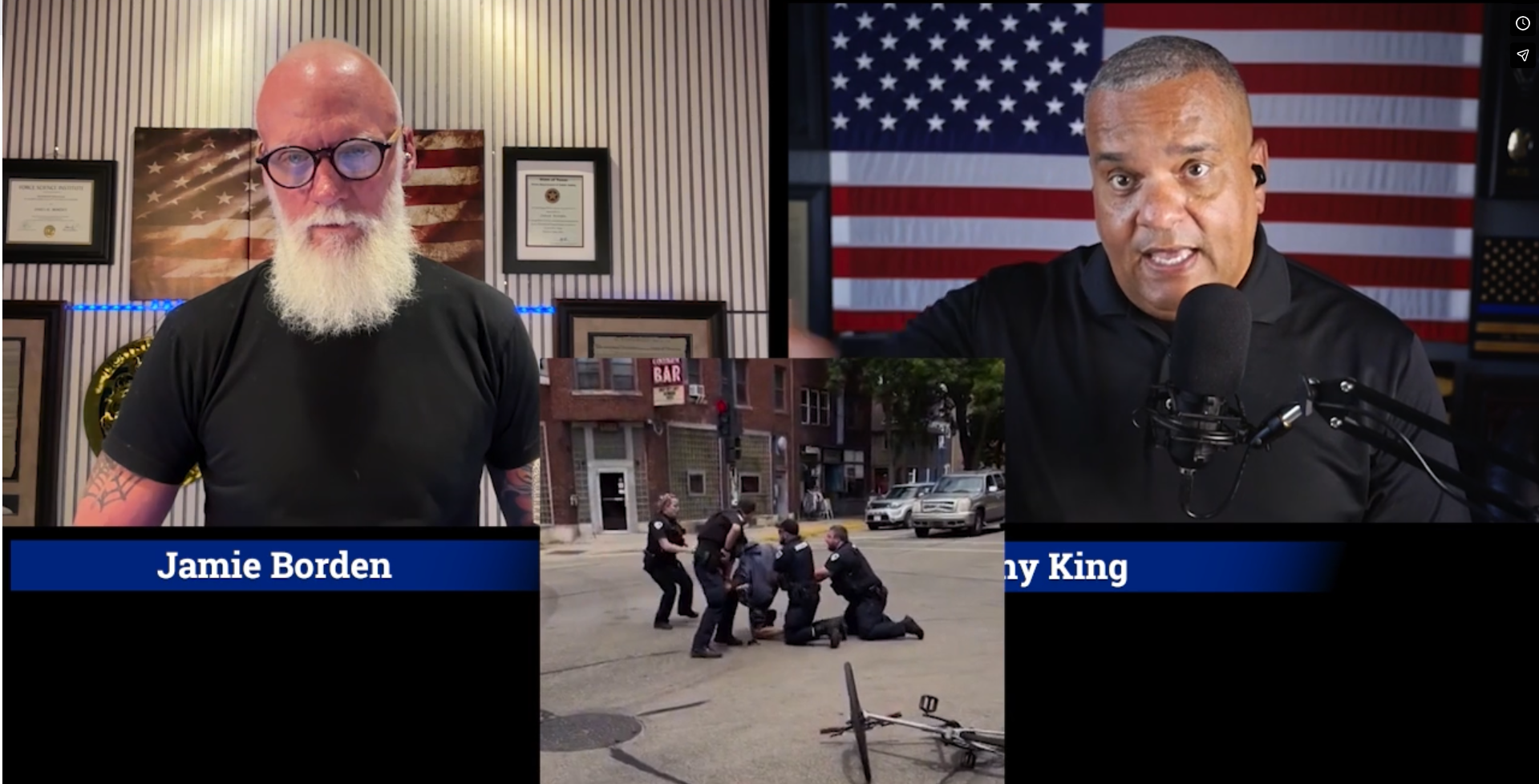
https://vimeo.com/manage/videos/1219390635 Why Police Use-of-Force Videos Mislead the Public: Two Use-of-Force Experts on the Madison Shooting of Corey Ruiz Jamie Borden